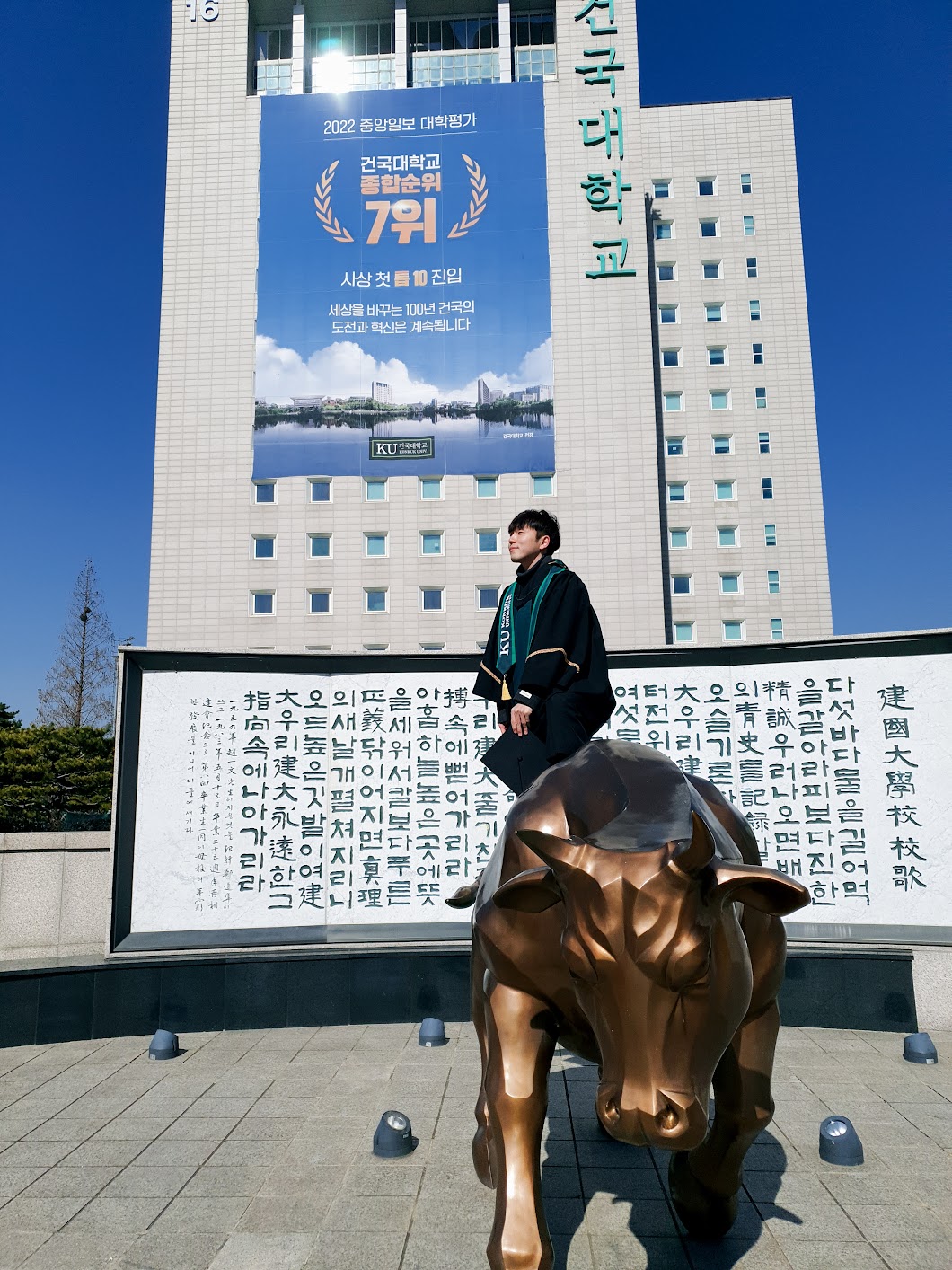
My undergraduate years were a slow process of aligning ideals with reality.
The profession I had dreamed of was medicine—directly caring for human life. But after three earnest attempts, that door never opened. I had to find another way. My reasoning at the time was simple: if I couldn’t tend to life itself, I would contribute to the environment in which life unfolds. That logic led me to choose Civil and Environmental Engineering.
Yet the regret of a choice born from compromise refused to fade. As a freshman, I drifted away from classes that felt foreign to me, oscillating between the library—where I sought wisdom for living—and drinking sessions that delivered instant dopamine. By the end of that year, all I had to show for it was two consecutive semesters on academic probation.
What cracked that stagnant pattern was twenty months of military service, followed by two months of travel across the United States. The army, with its constraints and solitude, forced me to look inward. America, with its freedom and connection, expanded my view outward.
As that journey of self-discovery drew to a close, the contours of a new direction began to take shape. A life spent indirectly protecting the environment still held meaning, but I found myself drawn more strongly to building tools that directly shape how people live.
With this shift in thinking, I returned to school as a sophomore with renewed resolve. My neglected GPA from freshman year made transferring to Electrical or Computer Engineering unrealistic. Instead, I was selected as a scholarship recipient in my department’s Software Convergence track, which allowed me to redesign my curriculum around the subjects I actually wanted to study. I took a wide range of CS courses—from foundational languages like C, Java, and Python to advanced topics in AI, computer vision, and digital image processing—and explored interdisciplinary applications such as smart cities and atmospheric modeling that bridged my original major with machine learning.
Beyond the technical, I pursued courses in law, business, economics, and psychology to deepen my understanding of people and society. Unwilling to stay within the boundaries set by formal education, I read and wrote across a broad spectrum—language, mathematics, science, technology, economics, humanity, society, politics, history, business, and culture—seeking to understand and articulate the world from multiple angles. I also gained firsthand experience in the real economy through doing startup and investing.
Through this journey of exploration, I cultivated two identities in tandem: a writer who reads and writes the world in bits, and a builder who reshapes it in atoms. One understands the world through language and contemplates the essence of problems; the other delivers answers in the form of products. These are not separate selves—they circulate endlessly within one being, like an ouroboros swallowing its own tail.
In my final semester, I joined a Natural Language Processing lab as an undergraduate researcher, taking my first step into the world of research. Now my gaze is fixed on Artificial General Intelligence. To explore what this technology truly means, to bring its possibilities into reality, to extend the limits of human intellect while ensuring its benefits are shared equitably across all of humanity—that is the path I intend to walk.